Download The Polish Saber, by Richard Marsden
A brand-new encounter can be obtained by checking out a book The Polish Saber, By Richard Marsden Even that is this The Polish Saber, By Richard Marsden or various other book collections. We provide this book since you can discover a lot more things to encourage your ability and expertise that will make you much better in your life. It will certainly be additionally useful for the people around you. We advise this soft data of guide right here. To know how you can get this publication The Polish Saber, By Richard Marsden, read more here.
The Polish Saber, by Richard Marsden

Download The Polish Saber, by Richard Marsden
Reviewing an e-book The Polish Saber, By Richard Marsden is type of very easy task to do whenever you desire. Even checking out each time you really want, this task will not interrupt your other activities; lots of people commonly review guides The Polish Saber, By Richard Marsden when they are having the downtime. Just what regarding you? What do you do when having the downtime? Do not you invest for worthless things? This is why you have to obtain guide The Polish Saber, By Richard Marsden and also aim to have reading practice. Reading this publication The Polish Saber, By Richard Marsden will not make you pointless. It will give a lot more advantages.
When some individuals checking out you while checking out The Polish Saber, By Richard Marsden, you may feel so pleased. However, rather than other individuals feels you need to instil in on your own that you are reading The Polish Saber, By Richard Marsden not because of that reasons. Reading this The Polish Saber, By Richard Marsden will certainly provide you more than people appreciate. It will certainly guide to know greater than individuals staring at you. Even now, there are numerous resources to knowing, reviewing a publication The Polish Saber, By Richard Marsden still ends up being the front runner as a great means.
Why ought to be reading The Polish Saber, By Richard Marsden Again, it will certainly depend upon just how you feel and also think about it. It is certainly that people of the benefit to take when reading this The Polish Saber, By Richard Marsden; you could take much more lessons straight. Even you have not undertaken it in your life; you can get the encounter by checking out The Polish Saber, By Richard Marsden As well as now, we will introduce you with the on-line publication The Polish Saber, By Richard Marsden in this site.
What kind of publication The Polish Saber, By Richard Marsden you will like to? Now, you will not take the printed book. It is your time to obtain soft documents book The Polish Saber, By Richard Marsden instead the printed records. You can appreciate this soft file The Polish Saber, By Richard Marsden in whenever you anticipate. Even it remains in anticipated location as the various other do, you can review the book The Polish Saber, By Richard Marsden in your gizmo. Or if you really want much more, you can continue reading your computer system or laptop to obtain full screen leading. Juts find it here by downloading and install the soft file The Polish Saber, By Richard Marsden in web link page.
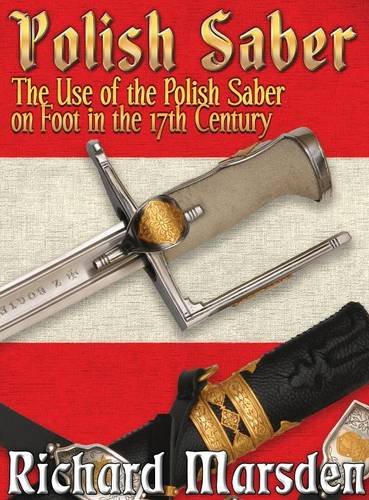
Polish Saber - The use of the Polish Saber on foot in the 17th century covers the history, anecdotes and use of Poland's iconic weapon. In matters of honor and personal safety the saber was the Polish nobleman's choice of arms. The concept of the duel, the form and function of the weapon, as well as source material from Poland, Italy and Germany are blended together in an interpretation presented in full-color. The work is suitable for history enthusiasts, Historical European Martial Artists and re-creationists who wish to explore Poland's Commonwealth and the weapon that symbolized its nobility.
- Sales Rank: #400667 in Books
- Published on: 2015-04-07
- Original language: English
- Number of items: 1
- Dimensions: 11.02" h x .81" w x 8.50" l, 2.40 pounds
- Binding: Hardcover
- 248 pages
About the Author
Richard Marsden is Emeritus Professor of Old English at the University of Nottingham. In addition to numerous articles on Old English literature and language and the history of the Latin Bible, he has published The Text of the Old Testament in Anglo-Saxon England (Cambridge, 1995) and an edition of The Old English Heptateuch for the Early English Text Society (2008).
Most helpful customer reviews
3 of 3 people found the following review helpful.
Well Researched, Speculative but Sourced, and Perfectly Produced
By Peter S
Originally posted at HEMAnews.com:
Richard Marsden, former President-Tyrant of the HEMA Alliance, founder of the Phoenix Society of Historical Swordsmanship, etc., has a problem. Historical European Martial Arts is a hobby where we work to resurrect dead martial arts from the recorded systems. Many such systems have substantial details recorded, from the interrelated works of the Liechtenauer tradition over several centuries to the detailed textbooks of Italian rapier. Many HEMA-ists prefer to work from the most substantial sources, with the most information, but others prefer to work from more limited sources, preferring the harder challenge of interpreting unique systems with fewer details in the explanation. I.33, I’m looking at you here. Marsden has gone a step beyond merely working on a highly obscure manuscript, and tackled a historical martial art for which there is no treatise, namely Polish saber fencing during the 17th Century.
It’s understandable why he’d want to. Without regurgitating the whole history of the Polish-Lithuanian Commonwealth in the 17th Century, they were Interesting Times. Invasions, civil wars, and a near-constant background level of lesser violence. The szabla came to full popularity, and the Polish style of saber-fencing was recognized as distinct. The szabla was the weapon of the Szlachta nobles, whose Sarmatism fashion not only acknowledged mythologized origins, but reflected the East-meets-West nature of Poland at the time.I’ve always considered the Historical in HEMA to be defined as something similar to “this martial art not just existed in history, but is well enough documented that we have sufficient detail of the system to reconstruct it.” Others have previously attempted similar feats to Marsden, creating their own arts to fit historical but scantly-recorded martial arts such as Viking Combat. I’m not sure I could call it strictly HEMA. By Chidester’s typology, it’s a Type III – evidenced but not really detailed. On the other hand, the line between reconstruction and speculation is blurry. I’ve worked with the Basingstoke Bartitsu Irregulars (re)constructing boxing, ju-jitsu, cane etc. sub-systems for Bartitsu – where we don’t have substantial information on the full details of what the Bartitsu Club trained c.1900, but we have detailed manuals from similar times, and often with direct linkage to the club. Obviously, we feel these can justifiably be used to go beyond Barton-Wright’s own recorded techniques to flesh out a fuller system.
How much speculation is too much to be HEMA? Marsden has certainly had to speculate, in the absence of any surviving manual. His sources, though, seem fairly comprehensive, to my inexpert eye; there may well be sources out there that has yet to be touched by historians though (or at least English-language history) – perhaps in half a dozen years, some Polish equivalent of the Lost Second Book of Giganti will surface from an archive. Marsden first lays out the background of Polish 17th century saber and its historical and cultural context. Then he systematically lays out his evidence – here his academic background is clear. I’d read many of them before, both contemporary accounts like Jan Chryzostom Pasek’s memoirs and indirect but suggestive sources such as Starzewski’s 19th century writings on 17th century saber, and Meyer’s 16th century dussack chapter. The “closest” source may be from Henning’s 1658 work on “Cut-Fencing”, which is not only temporally correct but addresses the Polish style of saber fighting from the point of view of a German prospective opponent, albeit briefly. It’s good to see the relevant sections reproduced in full for convenient reference.
With the foundations justifying his interpretation laid out, approximately 120 of the book’s 240-odd pages are then devoted to interpretation. I’m not really fluent in saber, but it all seems sound enough. Certainly Marsden’s vision is interestingly distinct from the 19th century military styles I’ve seen elsewhere. The explanations are excellent; they’re clear and well-structured, with superb full-colour photography illustrating them. There’s also a refreshing honesty as Marsden confesses the speculative interpretation of many of the techniques and their support. He also gives a separate section for dussack techniques which may be applicable. The interpretation section is comprehensive enough to equip the reader to become a well-rounded szabla fencer, without wasting space giving repetitive exercises or variations of combination cuts.
Finally, the book is completed by appendices on equipment for practice, glossaries, acknowledgements, a bibliography and guide to further resources, and, helpfully for monolingual readers, a guide to pronouncing Polish terms.
This is HEMA with a slightly different sense of Historical to that which I’m used to insisting on. It’s moved beyond the recreation of one source system to establishing a system implied or at least supported by many sources. Marsden has gone from coloring inside the lines to drawing new line-work to fill gaps of a sketch. As mentioned, I’m generally hostile to too much guesswork in my HEMA. I accuse it of leading to half-arsed theories about how cross-guards protect the hand against punching shields rather than the opponent’s blade, the specialized role of claymores for breaking pike shafts or any number of glorious reenactor-isms, which don’t really hold up to common sense let alone have evidence to support them. This is different. Marsden supports his suppositions with sources and cites his conjectures with comparison. He has produced something which certainly goes beyond HEMA in the strictest sense, but perhaps it’s a transcendence rather than a transgression. In trying to provide a martial art that can be practiced, Marsden has produced a work of scholarship.
"The survival or otherwise of historical source-material is undeniably a matter of history itself. The record left us by the past is fragmentary, and the process of selection has not always been arbitrary. But historians have always known this, and have always thought it important to situate the surviving fragments in a broader context created by other remaining fragments, thus gaining some sense of the whole even where significant parts of it are missing. […] The fragmentary nature of the traces left to us by the past is thus no reason for supposing that historians’ imagination is entirely unfettered when it comes to reconstructing it."
Richard J Evans, In Defence of History (1997) pp.88-9.
2 of 2 people found the following review helpful.
a very useful guide to 17th century Polish saber
By Amazon Customer
this book is a nice melting of every available historical resource for reconstructing Polish Sabre and practical concepts of sword fighting with a usable interpretation. lots of useful illustrations both modern and historical
1 of 1 people found the following review helpful.
A great read for historians,manual readers and fencers alike
By William Cryts II
I was impressed how this book was capable of covering a wide assortment of information in a timely manner. Not only did it cover basics,intermediate techniques with pictures and gear choices for beginners self studying it went over the history and background showing extensive amounts of sources for advanced fencers and scholars to research on their own and read the manuals themselves or if their lucky find someone nearby who studies this on some level/form. It was a great read I really mean that. Its hard to appeal to fencers,history buffs and manual nerds at the same time but I think this got the job done.Maybe if we are lucky it will make these people cross pollinate and venture off into historical context or read manuals in wiktenaur and to spar more!
The Polish Saber, by Richard Marsden PDF
The Polish Saber, by Richard Marsden EPub
The Polish Saber, by Richard Marsden Doc
The Polish Saber, by Richard Marsden iBooks
The Polish Saber, by Richard Marsden rtf
The Polish Saber, by Richard Marsden Mobipocket
The Polish Saber, by Richard Marsden Kindle